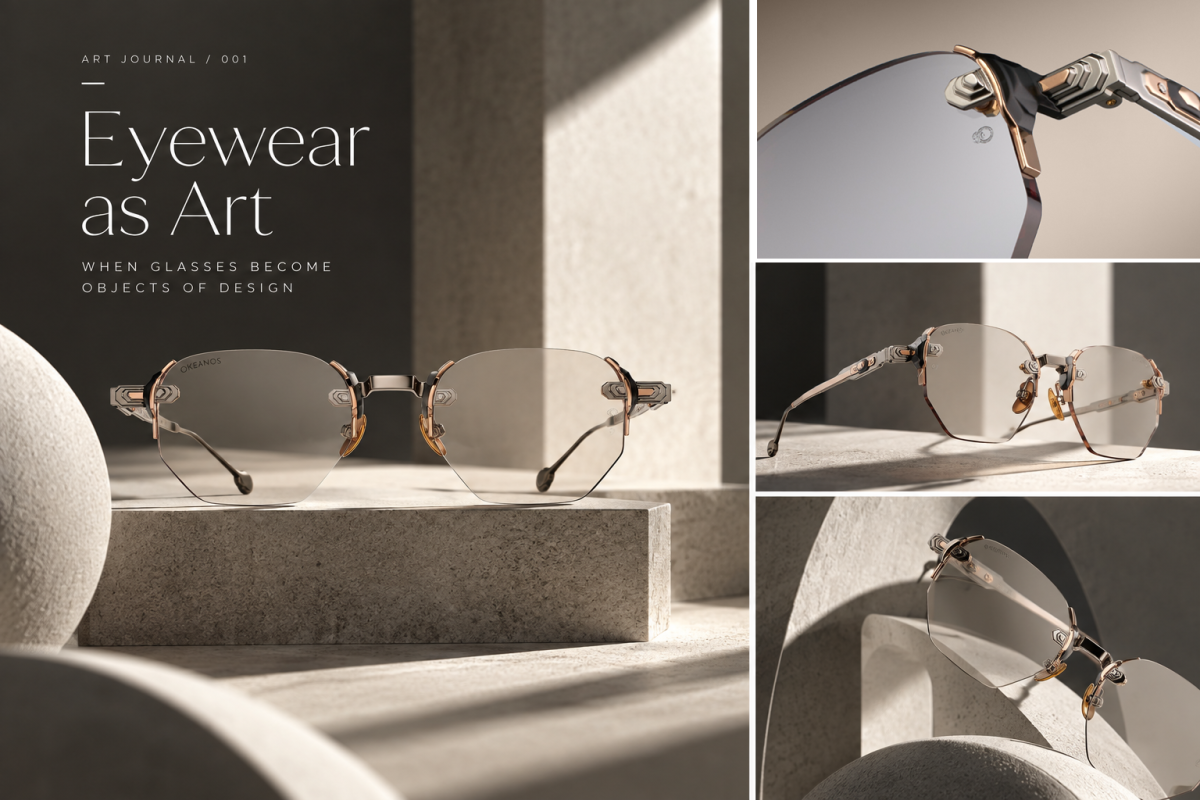
Eyewear as Art: When Glasses Become Objects of Design
On the relationship between sculpture, geometry, architecture and the objects we wear.
A frame is never just a frame.
It is a line drawn around the eyes. A structure that follows the architecture of the face. A composition of proportions, volumes and empty spaces.
For MASSADA, eyewear begins with an artistic question: what happens when an everyday object is approached with the sensibility of sculpture?
The answer lies not in decoration, but in form.
A curve can introduce movement. A geometric angle can create tension. A carefully considered bridge can transform the balance of an entire composition.
Like a sculpture, a pair of glasses exists in three dimensions. It changes as the wearer moves, interacts with light and establishes a relationship with the surrounding space.
The face becomes its architecture.
This perspective transforms eyewear from a purely functional accessory into an object of design — intimate in scale, yet capable of expressing a distinct artistic language.
Beyond Function: Eyewear as an Object of Design
Every designed object begins with a purpose.
A chair supports the body. A lamp directs light. A pair of glasses corrects or protects vision.
Yet function alone does not define the cultural or aesthetic significance of an object.
Throughout the history of modern design, architects, artists and designers have explored the relationship between utility and artistic expression. Everyday objects have become opportunities to investigate materials, structure, proportion and the experience of space.
Eyewear belongs to this conversation.
A frame must respond to the practical requirements of the human face, but within those constraints lies an extraordinary range of creative possibilities.
The thickness of a line, the geometry of a lens opening, the transition between the bridge and the rims, or the relationship between the front and the temples can fundamentally alter the character of a design.
These decisions are not merely decorative.
They determine how an object occupies space, how it is perceived and how it relates to the person wearing it.
In this sense, designer eyewear can be understood as a meeting point between industrial design, personal expression and artistic exploration.
The Influence of Modern Art on Eyewear Design
Modern art challenged the idea that representation was the only purpose of artistic creation.
Artists began to investigate the fundamental elements of visual language: line, colour, geometry, rhythm, volume and spatial relationships.
For eyewear design, these ideas offer a way of thinking about form beyond conventional stylistic categories.
Constructivism: Structure as Expression
Constructivism emerged in the early twentieth century, particularly in Russia, with an emphasis on construction, materials and the relationship between art and modern life.
Artists such as Alexander Rodchenko explored geometry, spatial organisation and the visual possibilities of industrial forms.
The movement offers a compelling conceptual framework for understanding eyewear.
A frame is itself a construction.
Its components must work together as a coherent system. The bridge connects two visual fields. The temples extend the composition into space. The rims establish the relationship between the eyes and the surrounding structure.
When construction becomes an intentional part of the visual language, the frame can express more than its practical function.
Its engineering becomes part of its identity.
Suprematism: The Power of Pure Geometry
Kazimir Malevich's Suprematism explored non-representational compositions built from fundamental geometric forms.
Squares, circles, rectangles and dynamic relationships between shapes became the vocabulary of an art concerned with pure visual experience.
In eyewear, geometry carries a similarly expressive potential.
A circular frame can establish a sense of continuity. A rectangular silhouette introduces direction and structure. An angular composition creates tension between lines and planes.
The interest lies not in reproducing a painting as a wearable accessory, but in understanding how elementary forms can generate complex visual relationships.
Geometry becomes a language rather than an ornament.
Sculpture You Can Wear
Unlike a painting, which is generally experienced from a principal viewing plane, sculpture occupies physical space.
Its appearance changes with the position of the observer, the direction of light and the relationship between solid form and empty space.
Eyewear shares this three-dimensional condition.
A frame may appear geometrically precise from the front, yet reveal an entirely different character in profile.
The curvature of a temple, the projection of a bridge or the transition between surfaces introduces additional layers to the composition.
Modern sculptors such as Barbara Hepworth and Alexander Calder offer important perspectives on these relationships.
Hepworth explored the interaction between mass, openings and surrounding space. Calder introduced movement and balance into sculptural compositions.
Their work encourages us to consider not only the visible material of an object, but also the space it defines.
In eyewear, the openings surrounding the lenses are as significant to the composition as the frame itself.
The space between the lenses establishes rhythm. The distance between the temples determines the object's extension. The relationship between solid and open elements influences its visual weight.
A sculptural approach to eyewear design therefore concerns the entire object, including the spaces within and around it.
The Architecture of the Face
Architecture is concerned with structure, proportion, scale and the organisation of space.
These principles can also be applied to the design of eyewear.
The human face provides a complex architectural context. Its proportions are individual, its surfaces are curved and its expression is constantly changing.
A frame must establish a relationship with this existing structure.
It may follow the natural lines of the face, introduce a contrasting geometry or create a new visual balance.
The bridge becomes a central structural element. The rims define the composition around the eyes. The temples extend the object beyond the frontal plane.
Every dimension participates in the final expression.
This is why the smallest adjustment can transform the character of a pair of glasses.
A slightly different angle, a narrower connection or a change in the relationship between the upper and lower lines may alter the entire composition.
The challenge is to create an object that is visually distinctive while remaining responsive to the person who wears it.
Architecture becomes intimate.
Material, Light and Perception
The character of eyewear is also shaped by its material presence.
A polished surface reflects light differently from a matte one. A thin metallic line produces a different visual impression from a broad, solid structure.
Colour can emphasise a silhouette or soften its boundaries. Transparency may reveal construction that an opaque material would conceal.
These qualities influence the way a frame is perceived.
Light moves across its surfaces, reveals its edges and creates subtle changes in contrast.
As the wearer turns, the relationship between material and illumination changes.
The object is never entirely static.
This interaction is particularly significant in sculptural eyewear, where the visual effect depends not only on the frontal silhouette but also on depth, reflection and the relationship between surfaces.
Material is therefore more than a technical choice.
It becomes an active element of the composition.
Beyond Fashion: A Lasting Artistic Language
Fashion is often associated with seasonal change.
Art and design, however, can also be understood through ideas that remain relevant beyond a particular moment.
Geometry, proportion, balance and spatial relationships are not confined to a single trend.
They form part of a visual vocabulary that artists and designers continue to reinterpret.
For an independent eyewear brand, this creates an opportunity to develop a recognisable design language rather than rely exclusively on temporary stylistic references.
An object may feel contemporary without depending on novelty alone.
Its identity can emerge from the precision of its proportions, the clarity of its construction and the coherence of its artistic intention.
The result is eyewear that invites attention not simply because it is unusual, but because its form has been considered.
MASSADA: Art as a Point of Departure
At MASSADA, art is not approached as a decorative reference.
It is a way of understanding form.
The precision of Constructivism. The reduction of Suprematism. The spatial sensitivity of modern sculpture. The relationship between object, movement and balance.
These ideas provide a conceptual language through which eyewear can be explored.
A line.
A volume.
A tension between forms.
The weight of a colour.
The space around an object.
Translated into eyewear, these elements acquire another dimension.
Sculpture becomes wearable. Architecture becomes personal. An everyday object becomes an OBJET d'ART — shaped by the face, yet conceived beyond function.
Art is where we begin.